Where people give up We read the funnel to pick what's worth testing first.
A written hypothesis You see the evidence behind it before anything gets built.
The variant, built We design and build it against your live theme, with no flicker.
The sample target, agreed up front We agree on it before launch, so nobody calls the test early because day four looked good.
The result, written down We record the number, window, sample size, and confidence, win or lose.
The winner shipped for good It goes into your theme for good, and the test log stays yours.
SERVICE FACTS
First 30 days
A funnel read of where shoppers drop off, a ranked list of what's worth testing, and the first test live
First test
Usually live inside three weeks, and decided four to six weeks after that
How often we test
One test cycle a month, run to a decision — not four half-finished ones
You'll need
Around 250 orders and 8,000 sessions a month. Under that, testing can't reach an answer and we'll say so
Core tools
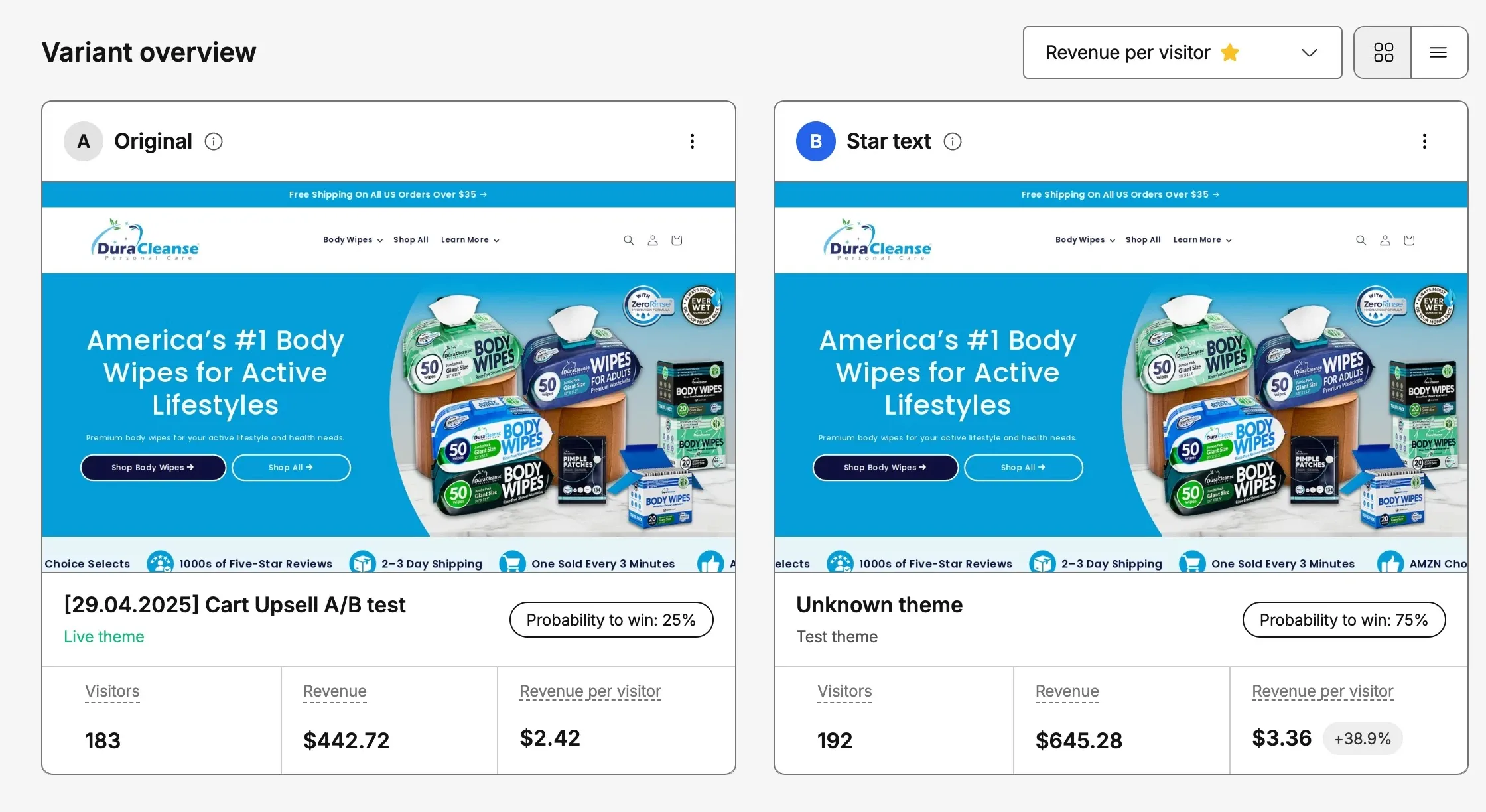
Shoplift on your own Shopify account ($99/mo and up, billed to you), plus your analytics — you keep all of it
Who you get
A conversion strategist who builds the variants, with design support — in your Slack
Minimum term
Three months — one month can't finish a test, and we'd rather say that than sell you one
Bigger stores
Past roughly 750 orders/mo we test twice as often; past 2,000 orders/mo we test checkout conversion and pricing directly
Your work
Winners stay in your theme, the test log is yours, and nothing is locked to us
How a test runs.
Week 0
Find where they give up
Walk the funnel step by step and find the drop-off that's costing you the most.
RESEARCH
Weeks 1–2
Write it down first
What we think will happen, why, which number decides it, and how much traffic it needs. Agreed before we build.
HYPOTHESIS
Weeks 2–3
Build the variant
Built against your real theme and checked on phones, desktop and Safari before a single shopper sees it.
BUILDING
Weeks 3–7
Run it to a decision
It runs until it hits the sample we agreed on — not until it looks good on a Tuesday.
RUNNING
Ongoing
Keep the winner, log the loss
Winners get built in properly. Losers get written up. Both point at what to test next month.
DECIDED
+8%
product-page add-to-cart lift from one test — Modified Tot, Q1 2026
One a month
A single test, with the traffic to answer, run to a decision. The arithmetic below explains why it isn't four.
Win or lose
Every result written up the same way. Most tests don't win — you'll see those too.
The arithmetic nobody puts on their pricing page.
Whether this is worth buying comes down to how big an improvement you're trying to spot. A test needs a certain number of orders in each version before the result means anything, and halving the improvement you want to detect roughly quadruples the traffic you need. Here it is for a store doing about 300 orders a month:
To spot an improvement of
Orders needed in each version
How long that takes
30%
~175
About 5 weeks
20%
~390
About 2.5 months
10%
~1,570
About 10 months
Ongoing
+8%
more shoppers adding to cart from the product page, from a single test
Modified Tot · A/B test · Q1 2026
One change, on the page where the decision actually gets made. Add-to-cart was the decision metric precisely because it happens often enough to answer inside a month.
At your traffic, only a large difference is detectable. So we test real changes — a different offer, a rebuilt product page, a different first screen — not tweaks that would need a year to prove.
The page where the money is decided
Product pages and cart before the homepage. Most stores get their homepage tested to death while the page that actually sells goes untouched.
Obvious breakage before clever ideas
If something is plainly broken on mobile, we fix it and move on. You don't need a four-week experiment to prove a broken form is bad.
"There's a plan: this one won, and now we're iterating on it. I love that we're consistently running different tests."
If you are still deciding what needs attention, our Free Shopify Store Audit can flag visible storefront issues. Check its findings against your own data before choosing a test.
Only one test a month? Other agencies promise four.
They do, and the arithmetic doesn't support it at your size — the table above shows the work. Four tests a month at a few hundred orders means four coin flips reported as findings. We run one test properly, on a metric that has the traffic to answer inside a month.
How much traffic do we need before this is worth buying?
Around 250 orders and 8,000 sessions a month, sustained. Below that a test cannot reach a decision in a sellable timeframe, and we will tell you so instead of selling you a retainer that can't finish. The honest option at that size is our Store Teardown — a one-time deep-dive CRO review with designed mockups — and implementation work. Our free conversion & AOV calculator shows what a lift would be worth at your volume.
What if the test loses?
Then you learned the change was wrong before you rebuilt your whole store around it, and you get the write-up anyway. Most well-designed tests do not win. An agency that only ever reports winners is not testing — it's shipping opinions and taking credit for whatever the season did.
Do you guarantee a lift?
No, and be careful with anyone who does. At a few hundred orders a month, a real 15% improvement and a lucky quarter look nearly identical from the outside — so a guaranteed lift is a promise about randomness. What we do guarantee is the process: a test built, run to its pre-registered sample target, and documented either way.
Which testing tool do you use, and who pays for it?
Shoplift, installed on your own Shopify account and billed to you directly — it starts at $99/mo and scales with your traffic. We don't mark it up or bury it in the retainer, and because it's yours, the account, the history and the test data stay with you.
Will testing slow the store down or make pages flash?
No. The old generation of testing tools swapped content in the browser after the page loaded, which is what caused the flicker everyone remembers. Shoplift renders the variant against your theme before the page reaches the shopper, so there's nothing to flash.
Doesn't Shopify Growth already cover this?
Shopify Growth ships changes and keeps the store healthy. This decides which changes were actually better. They work well together and neither replaces the other — Growth builds the winner properly once a test has found it.
What happens if we stop?
Every winner we shipped stays shipped — it's in your theme, not in a tool you're renting from us. The test log is yours, so the next person doesn't re-run the tests you already paid for. Cancel any time after the first three months.

 Plan
Plan Checklist
 Audit call



 What's in the box
 Week 0
 Weeks 1–2
 Weeks 2–3
 Weeks 3–7
 Ongoing